
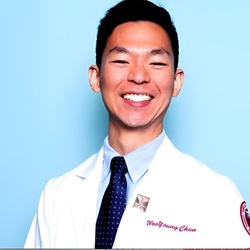
WooYoung Chun
Warren Alpert Medical School of Brown University; Kent Hospital, USAPresentation Title:
Is it safe to harvest a large segment of the fibula as part of lower extremity limb salvage: A pilot study to determine safety and functional outcomes in 5 patients
Abstract
Purpose: While fibular autografts have been increasingly utilized for limb-salvage reconstruction, the safety of harvesting a large fibular segment for lower extremity reconstruction remains unreported. This pilot study evaluates pain, donor-site morbidity, functional outcomes, and patient satisfaction following ipsilateral fibular strut autograft limb salvage reconstruction.
Method: Five patients (mean age 55 years) underwent ipsilateral fibular strut autograft lower extremity limb salvage reconstruction by a single foot and ankle surgeon. Patients who had at least 14 months of follow-up were systematically selected and retrospectively reviewed. The mean harvested fibular length was 15 cm. Fibular segments were assembled in a “railroad” configuration, using 7 struts for TTC fusion and 2 - 3 struts for medial column reconstruction. Standardized four questionnaires, adapted from the AOFAS Ankle/Hindfoot scoring scale, were used to assess postoperative pain, function, donor-site morbidity, and satisfaction.
Results: At final follow-up, no patient reported donor-site pain, weakness, or functional limitation. Three (60%) returned to normal activity, and two (40%) had “some difficulty” with ambulation; all showed improved gait. Four (80%) were satisfied with outcomes, and one was neutral. VAS pain scores ranged 0 - 3/10 in all cases. All patients achieved successful limb salvage and avoided major amputation.
Conclusion: Harvesting a large ipsilateral fibular autograft (average 15 cm) for lower extremity limb-salvage reconstruction appears safe and does not compromise post-operative functional outcome.
Biography
WooYoung Chun completed his Doctor of Podiatric Medicine (DPM) degree at the Temple University School of Podiatric Medicine (TUSPM) in 2023. He is the incoming Chief Foot and Ankle Surgical Resident at Kent Hospital. He has published several case reports, literature reviews, and retrospective studies

Organization Location
1309 Coffeen Avenue, STE 1200, Sheridan, Wyoming 82801, USA
General Enquiry
contact@scientexconferences.com
Finance Enquiry
finance@scientexconferences.com
Call us at
USA : (+1) 7579295846